About 264 minutes
The White Shield — Themes and Context
Adventure Picaresque Fiction
60,565 recorded words. 25 minutes difference from this book's estimate.
View Gutenberg source #47385
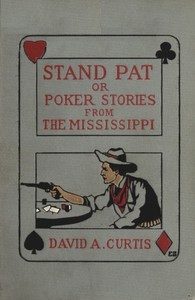
The catalog record for Stand Pat; Or, Poker Stories from the Mississippi — Background and Themes provides practical reading context through 54,748 words, 3 hr 59 min estimated reading time, and 6 detected text sections.
The text analysis averages about 21.1 words per sentence, while the detected sections provide another way to judge how the source is divided.
Project Gutenberg metadata also associates the work with “Short stories, American,” connecting these edition facts with the source record’s subject description.
Explore this collection
These alternatives are selected using recorded categories and estimated reading time.
About 264 minutes
Adventure Picaresque Fiction
60,565 recorded words. 25 minutes difference from this book's estimate.
View Gutenberg source #47385About 271 minutes
Adventure Picaresque Fiction
62,106 recorded words. 32 minutes difference from this book's estimate.
View Gutenberg source #9309About 271 minutes
Adventure Picaresque Fiction
62,202 recorded words. 32 minutes difference from this book's estimate.
View Gutenberg source #34365Search stored excerpts and compare books → Choose by your preferences →
Choices use stored catalog measurements. Estimates vary with reading speed. A shared category is a catalog label, not a claim that two books have the same argument or literary quality.
Search reads excerpt text stored with this catalog and links to its associated Gutenberg record. The connection is stored in the site database; this tool does not recheck that every excerpt is word-for-word identical to that external record. Excerpt search does not cover every chapter and does not verify historical publication dates.
Catalog snapshot checked: 2026-09-25. Coverage: 100 public books, 100 available source excerpts.
Read the complete public-domain text at its original source.
Read on Project GutenbergThe first chapter of Stand Pat opens with the steamboat Rosa Lee whistling into Brownsville, Arkansas, in June 1881, drawing the town's men from their buildings and women to their doors. This measured, communal response sets the stage for a collection that treats poker not as mere recreation but as a lens onto character and community. The narrator, old man Greenhut, frames each tale from his barroom vantage, his colloquial voice—full of biblical allusions and dry humor—shaping the stories as much as the cards themselves.
The character Stumpy, introduced in the first story, is an Irishman who insists he plays poker “fer spoort.” His method is theatrical: he turns up diamonds one by one, counting his winnings carefully before quitting despite protests. When accused of a dirty trick, he retorts, “Oi’ll not foight yez, on’y wan at a toime.” This blend of bluster and restraint defines him. The other players—Pearsall, Plunkitt, Winterbottom—are sketched through their reactions, not their histories. The excerpts offer no backstory for Stumpy; he appears fully formed, a catalyst for conflict and comedy. His dialect, rendered phonetically, marks him as an outsider in Arkansas City, yet he dominates the table through sheer audacity.
Old man Greenhut, the narrator, delivers a monologue on being “on hand” that doubles as a theory of luck. He laments that “the folks that ain’t thar all the time ain’t never thar,” using Tenspot Ike as his prime example. Ike, he says, is capable and liked but always absent when opportunity—figured as a bottle of rye or a hanging—presents itself. The story of how Ike got his nickname is promised but not fully told in the excerpt; Greenhut’s digression into a horse-thief lynching that lacked a Bible because Ike had the only copy illustrates the town’s rough justice and Ike’s untimely absence. The passage reveals Curtis’s interest in vernacular philosophy, where poker and morality intertwine.
The catalog lists Stand Pat under “Short stories, American” and “Poker players – Fiction,” but the excerpts show a stronger emphasis on local color and oral storytelling than on poker strategy. The game is a stage for dialect comedy and character revelation, not technical play. The setting—Brownsville, Arkansas, in 1881—is evoked through details like the steamboat whistle, the barroom cash-drawer, and the casual mention of a lynching. The female population is “seldom in evidence,” glimpsed only at doors. Curtis’s preface warns that he found the town “picturesque” and has “no quarrel” with it, framing the stories as selective memories rather than documentary reportage.
Readers approaching Stand Pat should expect a series of linked anecdotes rather than a novelistic plot. The pleasure lies in Greenhut’s voice and the cumulative portrait of a river town where poker is a social ritual and a test of nerve. The excerpts suggest that Curtis is less interested in who wins than in how the game exposes character—and how the teller shapes the tale.
Reading old Greenhut’s dry poker yarns in Brownsville, I found myself missing that same unhurried sprawl of river-town voices, the way a bluff can hold a whole life. It put me in mind of another quiet collection, where the telling matters more than the point. The Spread Eagle and Other Stories — Story, Setting & Ideas carries that same lingering, dust-settled warmth, like a porch creaking at dusk.
Save your reaction, strongest insight, and memorable passage.
![Cover of Waifs and strays [part 1] — Themes and Context](https://nceaa.com/storage/media/covers/pg2295.jpg)