About 271 minutes
In a steamer chair, and other shipboard stories — Context and Discussion
Adventure Picaresque Fiction
62,106 recorded words. 0 minutes difference from this book's estimate.
View Gutenberg source #9309
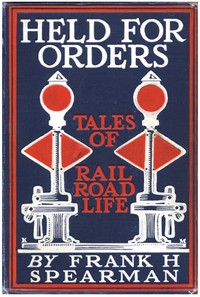
This digital edition of Held for Orders: Being Stories of Railroad Life — Story, Setting & Ideas is described by source-level measurements including 62,202 words, 4 hr 31 min estimated reading time, and 7 detected text sections.
The text analysis averages about 18.2 words per sentence, while the detected sections provide another way to judge how the source is divided.
Project Gutenberg metadata also associates the work with “Fiction,” connecting these edition facts with the source record’s subject description.
Explore this collection
These alternatives are selected using recorded categories and estimated reading time.
About 271 minutes
Adventure Picaresque Fiction
62,106 recorded words. 0 minutes difference from this book's estimate.
View Gutenberg source #9309About 264 minutes
Adventure Picaresque Fiction
60,565 recorded words. 7 minutes difference from this book's estimate.
View Gutenberg source #47385About 289 minutes
Adventure Picaresque Fiction
66,387 recorded words. 18 minutes difference from this book's estimate.
View Gutenberg source #15933Search stored excerpts and compare books → Choose by your preferences →
Choices use stored catalog measurements. Estimates vary with reading speed. A shared category is a catalog label, not a claim that two books have the same argument or literary quality.
Search reads excerpt text stored with this catalog and links to its associated Gutenberg record. The connection is stored in the site database; this tool does not recheck that every excerpt is word-for-word identical to that external record. Excerpt search does not cover every chapter and does not verify historical publication dates.
Catalog snapshot checked: 2026-09-25. Coverage: 100 public books, 100 available source excerpts.
Read the complete public-domain text at its original source.
Read on Project GutenbergThe first story, "Shockley," opens not with a train but with a pipe—a dry-goods-store pipe with a Beautiful Amber Mouthpiece that Callahan, the assistant superintendent, accidentally sets on fire. This small, absurd disaster sets the tone for Spearman's method: he builds character through the material details of railroad life, from atomizer tubes repurposed as pipe stems to the classified shipping of pie as ammunition. The men in these stories are defined by their tools, their nicknames (Bullhead, Jimmie the Wind), and their fraught relationships with rules, women, and whiskey.
Spearman's characters are often renamed by circumstance. Chris Ochsner becomes Chris Oxen because Callahan, making up the pay roll, thought it "better United States." Bullhead, whose real name is Jamie Lyons, is a boy who "had a passion for reading the rules"—a habit that marks him as odd in a world where instinct and nerve matter more than regulations. The stories repeatedly test men against the written code: the rule book is both a refuge and a joke. When Bullhead studies the rules to combat loneliness at Goose River Junction, it earns him only Nellie Cassidy's contempt. The tension between formal knowledge and practical survival runs through every tale.
Goose River Junction is so desolate that "even the buzzards play solitaire." The turnover of operators there is blamed on Nellie Cassidy, who despises the telegraph men and saves her preferred doughnuts for engineers and conductors. Spearman sketches the social hierarchy of the railroad with precision: the lunch counter is a stage where rank is performed. Bullhead, fresh from his detective and dentistry phases, is oblivious to Nellie's scorn until she tries cajolery—and her smile undoes him. The excerpt breaks off before we see the outcome, but the pattern is clear: in these stories, personal weakness (drink, pride, loneliness) is as dangerous as a washout on the line.
Spearman's prose is dense with the physical texture of railroading. Callahan, after losing his razor, "merely ran a pair of scissors over the high joints—for Callahan was railroading—and on the front." The phrase "for Callahan was railroading" is a terse explanation of why a man would neglect his shave: the work consumes everything. The stories are filled with such compressed observations—the "eighteen loads of steel" and "six cars of ties" pushed to the front, the "smart-uniformed young conductors" and "kerchiefed juvenile engineers" who command Nellie's respect. Spearman's eye for the specific (the circular saw used to practice tooth-pulling, the "muddy root" of a pipe that goes "unaccountably hot") gives the collection a documentary weight beneath its adventure surface.
These seven stories (the excerpts cover only the first two) reward a reader who pays attention to the tools, the nicknames, and the casual violence of railroad work. Spearman does not explain the hierarchy; he shows it in action—who gets the preferred doughnuts, who sweeps the office, who is trusted with a key. The collection is best read not as a series of plots but as a gallery of men (and a few women) shaped by the rails, where a mistake with a switch or a bottle can end a career or a life.
After all these years, I still think of Spearman’s switchmen, their lonely vigils framed by snow and semaphore. There is a quiet kinship between that patient watchfulness and the companionable silence one finds in Northern Lights, Volume 1. — A Reader’s Guide, where whole worlds wait, unhurried, for a steady hand to turn the page.
Build a private reading journal entry for this title.
![Cover of Waifs and strays [part 1] — Themes and Context](https://nceaa.com/storage/media/covers/pg2295.jpg)