About 166 minutes
Miss Mink's Soldier and Other Stories — Reading Companion
Fantasy Juvenile Worlds
37,983 recorded words. 8 minutes difference from this book's estimate.
View Gutenberg source #15230
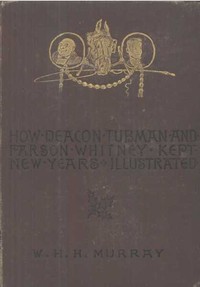
The source record for How Deacon Tubman and Parson Whitney Kept New Year's And Other Stories — A Reader’s Guide measures this digital text at 36,167 words, 2 hr 38 min estimated reading time, and 4 detected text sections.
The text analysis averages about 23.5 words per sentence, while the detected sections provide another way to judge how the source is divided.
Project Gutenberg metadata also associates the work with “Fiction,” connecting these edition facts with the source record’s subject description.
Explore this collection
These alternatives are selected using recorded categories and estimated reading time.
About 166 minutes
Fantasy Juvenile Worlds
37,983 recorded words. 8 minutes difference from this book's estimate.
View Gutenberg source #15230About 172 minutes
Fantasy Juvenile Worlds
39,473 recorded words. 14 minutes difference from this book's estimate.
View Gutenberg source #50271About 202 minutes
Fantasy Juvenile Worlds
46,394 recorded words. 44 minutes difference from this book's estimate.
View Gutenberg source #43008Search stored excerpts and compare books → Choose by your preferences →
Choices use stored catalog measurements. Estimates vary with reading speed. A shared category is a catalog label, not a claim that two books have the same argument or literary quality.
Search reads excerpt text stored with this catalog and links to its associated Gutenberg record. The connection is stored in the site database; this tool does not recheck that every excerpt is word-for-word identical to that external record. Excerpt search does not cover every chapter and does not verify historical publication dates.
Catalog snapshot checked: 2026-09-25. Coverage: 100 public books, 100 available source excerpts.
Read the complete public-domain text at its original source.
Read on Project GutenbergThe title story opens with Deacon Tubman waking on New Year's morning, muttering "New Year's, eh?" as he peers through a frosty window. His cheerful philosophy—"there's better fish in the net than we've taken out yet"—sets a tone of rustic optimism that runs through the collection. Murray's prose is lively, full of physical comedy: the deacon "bounced merrily out of bed and into his trousers," though only into one leg at first. The narrative voice is colloquial and amused, frequently addressing the reader directly with asides like "I say Deacon Tubman bounced into his trousers, but, to be exact, I should say that he bounced into half of them."
The deacon and the parson, despite their churchly titles, are not confined to pews. The story quickly moves outdoors, where the two men engage in a spirited sled race. The parson proves surprisingly adept at steering, and "it was found that the parson could steer a sled" becomes a minor revelation. Murray dwells on the physical details of the ride: the horse "Old Jack" is described as "a horse of a great deal of character," and the deacon urges him on with cries of "Go it, old boy!" The race is not merely a lark; it subtly underscores a contrast between the deacon's impulsive energy and the parson's composed skill. The setting—a snowy New England landscape—is rendered with specific touches like frosty window panes and the "colorless morning" creeping into sight. The humor is broad but affectionate, and the characters never become caricatures.
In "The Ball," the focus shifts to a festive gathering where a young fiddler, called simply "the Lad," unleashes a torrent of notes that "thrilled through the body and tingled along the nerves like successive electric shocks." The scene is a whirlwind of sound and motion: the music "jetted and effervesced its melody," the floor shakes, and an old Trapper—white-haired but spry—leads a jig with such abandon that he "forced the music by half a beat." Murray's description is kinetic and almost synesthetic, as the violin seems to "burst in musical explosions." The Trapper's exclamation—"Lord, who'd a thought that the blood in the veins of a man whose head is whitenin' could be sot leapin' as mine is doin' at this minit by the scrapin' of a fiddle!"—captures the story's theme of vitality persisting into age. The music stops "with a snap," leaving the room in applause.
The collection's remaining stories, "The Old Beggar's Dog" and "Who Was He?," introduce darker or more enigmatic elements. In the former, a beggar and his dog are "constant companions," and the dog is shown learning a new trick—a detail that hints at the bond between the pair. When an officer harasses the beggar, the crowd "hooted the officer roundly," suggesting a communal defense of the outcast. "Who Was He?" opens with John Norton watching an approaching fire, then shifts to a river scene where a deer springs from the bank and a mysterious figure appears. The four characters who sit "in silence by the fire" at the story's end leave the stranger's identity unresolved. Murray thus moves from comic realism to folkloric ambiguity, using the same plainspoken narrative voice throughout.
Readers will find that Murray's strength lies in his ear for dialogue and his ability to render physical action—whether a sled race, a jig, or a dog's trick—with precise, energetic prose. The stories are best approached as period entertainments, rich in local color and unpretentious humor. Pay attention to the recurring motif of motion: characters are always bouncing, racing, dancing, or chasing, and the language itself keeps pace.
Murray’s sledding deacons and strange strangers always left me with the ache of warm firelight against cold window glass. That same quiet hush hangs over Around the Yule Log — A Closer Reading, like hearing the same hymn hummed in a different key. I keep both on the shelf, old friends for snowy evenings.
Create a short personal record of your experience with this book.