About 302 minutes
Tales of Trail and Town — Background and Themes
Fantasy Juvenile Worlds
69,324 recorded words. 3 minutes difference from this book's estimate.
View Gutenberg source #2550
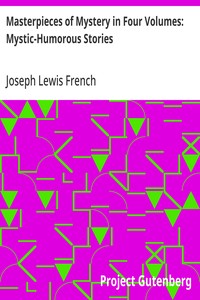
The catalog record for Masterpieces of Mystery in Four Volumes: Mystic-Humorous Stories — Background and Themes provides practical reading context through 68,755 words, 4 hr 59 min estimated reading time, and 8 detected text sections.
The text analysis averages about 19.8 words per sentence, while the detected sections provide another way to judge how the source is divided.
Project Gutenberg metadata also associates the work with “Short stories,” connecting these edition facts with the source record’s subject description.
Explore this collection
These alternatives are selected using recorded categories and estimated reading time.
About 302 minutes
Fantasy Juvenile Worlds
69,324 recorded words. 3 minutes difference from this book's estimate.
View Gutenberg source #2550About 310 minutes
Fantasy Juvenile Worlds
71,293 recorded words. 11 minutes difference from this book's estimate.
View Gutenberg source #8893About 279 minutes
Fantasy Juvenile Worlds
64,153 recorded words. 20 minutes difference from this book's estimate.
View Gutenberg source #27722Search stored excerpts and compare books → Choose by your preferences →
Choices use stored catalog measurements. Estimates vary with reading speed. A shared category is a catalog label, not a claim that two books have the same argument or literary quality.
Search reads excerpt text stored with this catalog and links to its associated Gutenberg record. The connection is stored in the site database; this tool does not recheck that every excerpt is word-for-word identical to that external record. Excerpt search does not cover every chapter and does not verify historical publication dates.
Catalog snapshot checked: 2026-09-25. Coverage: 100 public books, 100 available source excerpts.
Read the complete public-domain text at its original source.
Read on Project GutenbergJoseph Lewis French's 1922 anthology Masterpieces of Mystery: Mystic-Humorous Stories deliberately pairs the uncanny with the comic, a juxtaposition announced in its title. The foreword defines mysticism as an "intermediate ground between our knowledge of life and the unknown," and promises that humorists—"thank heaven, we always have with us"—can deflate spectres and terrors alike. The collection's structure moves between these poles: Algernon Blackwood's "May-Day Eve" opens with a folklorist's rational skepticism gradually eroded by a supernatural encounter, while Mark Twain's "Mr. Bloke's Item" offers a newspaper hoax that turns a ghost story into a punchline. French's selections, drawn from authors like Théophile Gautier, Arthur Machen, and Brander Matthews, create a deliberate rhythm of tension and release.
Several stories hinge on liminal spaces—gardens, hammocks, doorways—where the boundary between natural and supernatural blurs. In Blackwood's tale, the climax occurs in a garden hammock, a suspended space between indoors and outdoors, waking and dreaming. The narrator describes a "monstrous leaping shadow" cast on the lawn and an acrid smell "like a certain châlet in the Alps," grounding the eerie in sensory detail. Similarly, E. F. Benson's "The Man Who Went Too Far" uses a garden after a storm, where a scream shatters silence and a "black shadow" with "hard hoofs" skips away. These thresholds are not just settings but active agents: they mark points where characters cross from safety into encounter.
French's volume showcases how humor can reframe mystery. Mark Twain's contribution, "Mr. Bloke's Item," uses deadpan newspaper prose to report a ghostly visitation, undercutting the eerie with bureaucratic absurdity. The humorist, French writes, "takes nothing either in earth or heaven seriously." This tonal shift is structural: after Blackwood's atmospheric dread, Twain's piece offers comic relief. Brander Matthews's "The Rival Ghosts" similarly treats spectral rivalry with wit, while Chester Bailey Fernando's "Chan Tow The Highrob" blends detective work with cultural comedy. The anthology thus trains the reader to expect both shivers and smiles, often within the same story.
The stories frequently move characters from domestic interiors to exposed outdoor spaces, mirroring a psychological journey from safety to vulnerability. In "May-Day Eve," the narrator travels from the hospital to a friend's country house, then from the house to the garden at night. Benson's tale shifts from a bedroom to a terrace to a hammock, each step increasing exposure. This spatial progression is echoed in Fitz-James O'Brien's "The Diamond Lens," where the protagonist's obsession drives him from his study into a microscopic world. The editor's arrangement amplifies this pattern: interior scenes of conversation or reflection give way to exterior confrontations, creating a rhythm of retreat and advance.
French's foreword and acknowledgments reveal a deliberate curatorial strategy. He thanks Brander Matthews, Anna Katharine Green, and others for "helpful advice and suggestion," and notes that some stories appear "for the first time in any collection." The volume is part of a four-volume series, each with a different thematic focus (mystic-humorous, ghost, detective, etc.). French's selection favors authors known for both popular and literary appeal: Blackwood, Machen, Conan Doyle, Maupassant. By grouping them under a single rubric, he invites comparison across styles. The table of contents shows a careful alternation: Blackwood's long opener, then O'Brien's scientific horror, Gautier's exotic fantasy, Twain's comic piece—a sequence that keeps the reader off-balance.
Readers approaching this collection should attend to the interplay between its two promised modes. The mystic stories often build dread through sensory detail—smells, shadows, sounds—while the humorous ones deflate that same dread through irony or absurdity. French's arrangement rewards reading in order, as each story comments on the one before. For those interested in early twentieth-century genre blending, this volume offers a curated sample of how mystery writers experimented with tone, moving between the eerie and the comic without settling into either.
There’s something about French’s foreword—that notion of mysticism as the quiet middle ground—that lingered with me long after I put the anthology down. It made me think of a different book I once came across, one that treats the supernatural with the same gentle, amused hand. My Father, the Cat — Background and Themes shares that curious warmth, as if the strange were simply part of family life, nothing to fear or explain away.
Build a private reading journal entry for this title.