About 338 minutes
The Exiles and Other Stories — Edition Insights
Historical Psychological Social Fiction
77,544 recorded words. 3 minutes difference from this book's estimate.
View Gutenberg source #16090
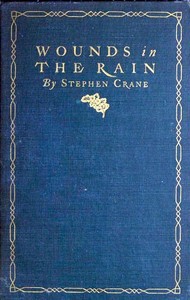
Before opening Wounds in the rain: War stories — Reading Companion, the edition data offers a quick orientation: 77,050 words, 5 hr 35 min estimated reading time, and 7 detected text sections.
The text analysis averages about 15.3 words per sentence, while the detected sections provide another way to judge how the source is divided.
Project Gutenberg metadata also associates the work with “Short stories, American,” connecting these edition facts with the source record’s subject description.
Explore this collection
These alternatives are selected using recorded categories and estimated reading time.
About 338 minutes
Historical Psychological Social Fiction
77,544 recorded words. 3 minutes difference from this book's estimate.
View Gutenberg source #16090About 355 minutes
Historical Psychological Social Fiction
81,429 recorded words. 20 minutes difference from this book's estimate.
View Gutenberg source #38517About 358 minutes
Historical Psychological Social Fiction
82,150 recorded words. 23 minutes difference from this book's estimate.
View Gutenberg source #2459Search stored excerpts and compare books → Choose by your preferences →
Choices use stored catalog measurements. Estimates vary with reading speed. A shared category is a catalog label, not a claim that two books have the same argument or literary quality.
Search reads excerpt text stored with this catalog and links to its associated Gutenberg record. The connection is stored in the site database; this tool does not recheck that every excerpt is word-for-word identical to that external record. Excerpt search does not cover every chapter and does not verify historical publication dates.
Catalog snapshot checked: 2026-09-25. Coverage: 100 public books, 100 available source excerpts.
Read the complete public-domain text at its original source.
Read on Project GutenbergStephen Crane’s Wounds in the Rain opens not with a charge but with twenty-five men making a road—digging and smoothing that, as the narrator notes, “gains no encrusted medals from war.” This early choice establishes a pattern: Crane trains his eye on the unglamorous labor, the waiting, and the small, telling gestures of soldiers under pressure. The prose is lean, often ironic, and packed with sensory detail—the “tiny ruby of light” from a cooking fire, the “grimy yellow face” of a marine after a night in the trench. Across these stories, Crane’s authorial voice oscillates between a reporter’s detachment and a participant’s weary intimacy, creating a distinctive tension that shapes every scene.
Crane’s word choices consistently undercut heroic expectation. In “The Price of the Harness,” the men work “like gardeners,” and the road is “growing from the old pack-animal trail.” The simile domesticates military labor, while the verb “growing” suggests a natural, almost botanical process—not a feat of arms. Later, the Cuban dusk is described as one “in which the shadows are all grim and of ghostly shape,” a phrase that shifts from the mundane to the spectral without warning. Crane often pairs plain nouns (“shovels,” “picks,” “canteens”) with adjectives that carry a charge of dread (“grim,” “ghostly”). This juxtaposition keeps the reader off-balance, alert to the way danger can seep into the most routine moments.
When characters speak, they rarely declaim. In the excerpt from “Marines Signalling under Fire at Guantanamo,” a colonel and a private stand side by side under heavy fire. The adjutant protests, and the colonel replies, “Oh, it’s all right, Draper.” The casual dismissal, the use of the adjutant’s name, the lack of any grand sentiment—all mark Crane’s preference for understatement. Later, the signalman Clancy, after risking his life to wigwag a message, “swore at times” and then “dropped like a brick into the firing line and began to shoot; began to get ‘hunky’ with all those people.” The colloquial “hunky” and the verb “dropped” (rather than “dove” or “rushed”) strip the action of heroism, presenting it as a matter-of-fact, almost mechanical response.
Crane repeatedly describes soldiers’ bodies as objects acted upon by heat, exhaustion, and fear. In the Guantanamo account, marines are “red and sweating like so many hull-buried stokers in the tropics.” The simile compares them to engine-room workers, not warriors. The sky is “bare and blue, and hurt like brass”—a synesthetic image that makes the atmosphere itself painful. When Clancy stands silhouetted against the sky, the narrator notes that “the usual thing happened”: the Spaniards shoot at him. The phrase “the usual thing” implies a grim pattern, a law of combat that Crane’s descriptions make visceral. Even relief is physical: after a night in the trench, men “grinned with weary satisfaction,” and the narrator admits it took “some hours to get my nerves combed down.”
Crane often disrupts linear storytelling with sudden shifts in scale or perspective. In “The Price of the Harness,” the road-building scene is interrupted by a “volunteer staff-officer” who asks “questions which were apparently not relevant to any military business.” The detail is left unexplained, creating a small pocket of absurdity. Later, a single rifle-shot comes “from somewhere in the world,” the vague phrasing expanding the setting beyond the immediate scene. In the Guantanamo piece, the narrative jumps from the colonel and private to the aftermath (“Day was always obliged to come at last”) and then to a flashback about Clancy. These structural breaks mirror the disjointed experience of combat, where attention is pulled between the trivial and the lethal.
Crane’s stories reward attention to the spaces between action—the moments when men wait, dig, or simply endure. His diction, dialogue, and descriptive choices consistently resist the language of official heroism, favoring instead the concrete, the ironic, and the bodily. Readers will find that the most revealing passages are often the quietest: a soldier’s muttered oath, the color of a neckerchief used as a flag, the way fatigue settles into a grin. These details, not the battles, are where Crane’s craft is most evident.
I remember staring at rain-streaked windows after reading Crane’s stretcher-bearers—that hollow quiet between thunder and dread. It reminded me of sitting with The Man of Adamant (From: "The Snow Image and Other Twice-Told Tales") — Context and Discussion, where stone-hearted solitude felt equally inevitable, equally human. Both books left a rough, salt-and-rust taste, less like war stories and more like prayers said without needing an answer.
Build a private reading journal entry for this title.