1

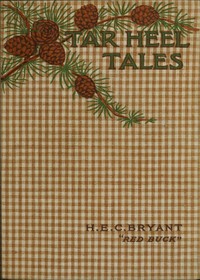
Tar Heel Tales — Edition Insights
(0 User reviews)
92
Project Gutenberg
2017
Not confirmed
Short stories, American; African Americans -- Fiction; North Carolina -- Social life and customs -- Fiction
Readers of public-domain and historical texts
Project Gutenberg digital edition
en
Edition facts
Words
42,519
Reading time
185 min
Text sections
5
Before opening Tar Heel Tales — Edition Insights, the edition data offers a quick orientation: 42,519 words, 3 hr 5 min estimated reading time, and 5 detected text sections.
The text analysis averages about 16.3 words per sentence, while the detected sections provide another way to judge how the source is divided.
Project Gutenberg metadata also associates the work with “Short stories, American,” connecting these edition facts with the source record’s subject description.
Source:
Project Gutenberg record #54470
H. E. C. Bryant's 1910 collection of North Carolina dialect stories, centered on African American camp meetings and rural life, with a focus on the prophetess Arabella Simpkins and the author's persona 'Red Buck.'
Read the complete public-domain text at its original source.
Read on Project GutenbergIn Tar Heel Tales, H. E. C. Bryant—writing under the nickname “Red Buck”—collects stories drawn from his travels as a correspondent for The Charlotte Observer. The preface, quoting Harry Myrover, praises Bryant’s “clean, wholesome humor” and claims his dialect stories rival those of Joel Chandler Harris. The catalog subjects list “African Americans – Fiction” and “North Carolina – Social life and customs,” but the excerpts reveal a specific focus: the Reding Springs camp meeting, a yearly religious gathering for “the country negro.” Bryant’s narrator attends as an observer, describing the scene with a mix of ethnographic detail and comic distance.
The Prophetess and the Camp Meeting
The longest excerpt details the arrival of Arabella Simpkins, a “prophetess” feared and respected by the Reding Springs community. Bryant describes her as a “big negress” who predicts disasters—a storm in 1882, an earthquake in 1886, a lightning strike in 1898—and delivers her prophecies when “excitement ran highest.” The narrator arrives with “a party of young people” specifically to see her, suggesting the tales blend reportage with entertainment. Bryant’s voice is that of an outsider, noting the variety of vehicles (“antiquated carriages, buggies and two-wheeled carts”) and the straw cushions in wagons. The depiction of Arabella’s performance—humming softly, walling her eyes—emphasizes spectacle over interiority, raising questions about how the stories represent African American religious practice.
Dialect, Voice, and the Author’s Persona
The preface establishes Bryant’s persona: a “auburn haired Scotch-Irishman” nicknamed “Red Buck” by his editor, a name that became “state property.” The stories are framed as authentic products of his statewide travels, yet the excerpts show a clear narrative distance. Dialect is rendered for characters like Parson Honeycutt (“I’m ’clined to b’lieve dat you is kerrect”), while the narrator uses standard English. This linguistic divide positions the tales as local color rather than insider accounts. Bryant’s humor, as described by Myrover, “is liable to break out at any time—even in church,” and the excerpt’s tone—calling Arabella’s predictions “an omen for good or bad”—balances curiosity with mild irony. The catalog subject “Short stories, American” fits, but the focus on a single extended scene suggests the collection may be more unified than the label implies.
What the Catalog Subjects Omit
The catalog lists “North Carolina – Social life and customs” and “African Americans – Fiction,” but the excerpts reveal a narrower lens: the camp meeting as a site of religious fervor and community hierarchy. Bryant notes that the meetings are “not for the city-bred negro, with his lofty airs and college training,” explicitly distinguishing class within the African American population. The stories also foreground a white narrator’s perspective, a dynamic the catalog subjects do not capture. The preface’s dedication to Joseph Pearson Caldwell, editor of The Charlotte Observer, and the inclusion of Myrover’s praise, indicate the book’s origin in newspaper work and regional literary circles. Readers should note that the excerpts provide no evidence of plot beyond the camp meeting; the collection’s other tales remain unknown from this sample.
Tar Heel Tales offers a particular kind of regional fiction: one where the author’s persona is as much a character as the subjects he describes. Readers interested in early twentieth-century representations of African American life, or in the newspaper origins of local color writing, will find this a focused example. The excerpts suggest a work that rewards attention to its framing devices—the preface, the narrator’s role—as much as to the dialect stories themselves.
In Bryant’s Tar Heel Tales, Arabella Simpkins speaks with a truth that bends the air around her. Years later, I find that same unhurried, otherworldly certainty in The Intoxicated Ghost, and other stories — Inside the Classic, where spirits linger not for shock, but for quiet company. Both books share that reverence for a voice which listens before it answers. A gentle, lasting echo.
There are no reviews for this eBook.
There are no comments for this eBook.
Reader reflection
What did you think of this book?
Answer a few questions and save a private reflection on this device.
Your progress
0
/
10
2
What was your overall reaction to the book?
3
How likely are you to recommend this book?
4
How demanding did the text feel?
5
Did it raise ideas you would like to talk about?
6
How clear did the writing feel?
7
Did the book deliver what you hoped for?
8
How strongly did the book affect you emotionally?
9
In one sentence, what did you learn?
10