About 95 minutes
Parables of a Province — Reading Notes
Science Fiction Utopias
21,739 recorded words. 23 minutes difference from this book's estimate.
View Gutenberg source #6242
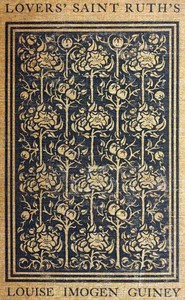
The source record for Lovers' Saint Ruth's, and Three Other Tales — Background and Themes measures this digital text at 27,002 words, 1 hr 58 min estimated reading time, and 9 detected text sections.
The text analysis averages about 18.7 words per sentence, while the detected sections provide another way to judge how the source is divided.
Project Gutenberg metadata also associates the work with “Short stories, American,” connecting these edition facts with the source record’s subject description.
Explore this collection
These alternatives are selected using recorded categories and estimated reading time.
About 95 minutes
Science Fiction Utopias
21,739 recorded words. 23 minutes difference from this book's estimate.
View Gutenberg source #6242About 147 minutes
Science Fiction Utopias
33,758 recorded words. 29 minutes difference from this book's estimate.
View Gutenberg source #2278About 168 minutes
Science Fiction Utopias
38,512 recorded words. 50 minutes difference from this book's estimate.
View Gutenberg source #26995Search stored excerpts and compare books → Choose by your preferences →
Choices use stored catalog measurements. Estimates vary with reading speed. A shared category is a catalog label, not a claim that two books have the same argument or literary quality.
Search reads excerpt text stored with this catalog and links to its associated Gutenberg record. The connection is stored in the site database; this tool does not recheck that every excerpt is word-for-word identical to that external record. Excerpt search does not cover every chapter and does not verify historical publication dates.
Catalog snapshot checked: 2026-09-25. Coverage: 100 public books, 100 available source excerpts.
Read the complete public-domain text at its original source.
Read on Project GutenbergLouise Imogen Guiney's 1895 collection opens with a confession: the title story was, 'from end to end, a dream.' That admission sets the tone for four tales that prize psychological atmosphere over plot mechanics. The author's preface also reveals a curious parallel with Thomas Hardy—both writers independently adapted the same real-life Dublin suicide of a child, though Guiney altered her ending under a friend's advice. Throughout, Guiney's prose is attentive to the weight of a single gesture or phrase, as when a character breathes a line from the Psalms: 'Lover and friend hast Thou put far from me.'
Guiney's characters often speak little, yet their interior lives are dense. In the excerpt, Openshaw is described as 'a gentle, negative soul, to whom he confided little of what touched him most.' The narrator dwells on what is withheld: 'He had formed no intimate companionships.' This restraint extends to the dialogue, which is spare but loaded. When Openshaw encounters the Italian, their exchange is courtly and indirect—'I thank you. Perhaps you would rather have me say, molte grazie'—revealing class and distance through word choice. The author's preference for precise, slightly formal language ('bulwarked about with modern conveniences') gives the prose a measured, almost antiquated dignity.
One of the most striking authorial choices is the insertion of a complete folk-song into the narrative. The Italian girl sings 'All in the April evening,' a Christian lyric about lambs and the Lamb of God. The song is not merely decorative; it contrasts sharply with Openshaw's 'spiritual darkness' and 'bitter evenfall.' Guiney lets the song stand in full, its simple rhyme and repetition ('The sheep with their little lambs / Passed me by on the road') creating a pause that deepens the emotional register. The effect is to juxtapose public piety with private despair, a technique that recurs across the collection.
Guiney's narratives often hinge on what is left unresolved. In the preface, she describes altering the ending of 'The Provider' so that the boy dies alone rather than with his sister—a change that preserves ambiguity. The excerpt itself ends on a note of suspended action: Openshaw and the Italian 'confronted, smiled a little,' then begin a conversation that feels both inevitable and uncertain. The author avoids tidy conclusions; instead, she builds scenes around a single charged encounter—a song overheard, a hat returned—and lets the emotional aftermath linger. This structural preference for the fragmentary over the complete aligns with her claim that the first tale was 'a dream.'
Guiney uses setting sparingly but with precision. The excerpt places Openshaw on a wharf at midday, 'the morning heaven blessing' the young lovers while he sits in 'spiritual darkness.' The physical environment—the 'windless air,' the passing boat, the 'angle of the wall'—becomes a stage for interior conflict. Later, the Italian's 'gypsy princeliness' and 'clear pallor' are described as a 'nameless magic that takes the heart,' linking appearance to an almost supernatural allure. The author does not over-describe; a few details—'abundant glossy black and gray' hair, 'a land of bald pates'—suffice to fix a character in space and mood.
These four tales reward attention to the spaces between words—the hesitations, the songs, the unspoken longings. Guiney's authorial choices, from her deliberate diction to her use of lyric interruption, create a world where interior states are more vivid than external action. Readers who approach the collection as a study in restraint and resonance will find its quiet power enduring.
Reading Lovers' Saint Ruth's reminded me of an autumn evening when I sat with my grandmother, who told me about the Dublin she left behind—her voice hushed, carrying the weight of unspoken things. Guinéy’s precise diction does that, makes interior silence feel monumental. I felt it again with Children of the Tenements — Themes and Context, where crowded rooms somehow held so much loneliness.
Answer a few questions and save a private reflection on this device.





![Cover of Heart of the West [Annotated] — Edition Insights](https://nceaa.com/storage/media/covers/pg13094.jpg)