About 190 minutes
In Homespun — Reading Companion
Science Fiction Utopias
43,633 recorded words. 5 minutes difference from this book's estimate.
View Gutenberg source #4378
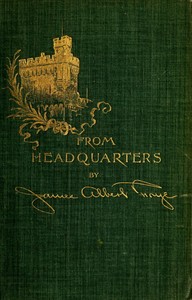
This digital edition of From Headquarters: Odd Tales Picked up in the Volunteer Service — A Reader’s Guide is described by source-level measurements including 42,341 words, 3 hr 5 min estimated reading time, and 4 detected text sections.
The text analysis averages about 24.5 words per sentence, while the detected sections provide another way to judge how the source is divided.
Project Gutenberg metadata also associates the work with “Short stories, American,” connecting these edition facts with the source record’s subject description.
Explore this collection
These alternatives are selected using recorded categories and estimated reading time.
About 190 minutes
Science Fiction Utopias
43,633 recorded words. 5 minutes difference from this book's estimate.
View Gutenberg source #4378About 168 minutes
Science Fiction Utopias
38,512 recorded words. 17 minutes difference from this book's estimate.
View Gutenberg source #26995About 147 minutes
Science Fiction Utopias
33,758 recorded words. 38 minutes difference from this book's estimate.
View Gutenberg source #2278Search stored excerpts and compare books → Choose by your preferences →
Choices use stored catalog measurements. Estimates vary with reading speed. A shared category is a catalog label, not a claim that two books have the same argument or literary quality.
Search reads excerpt text stored with this catalog and links to its associated Gutenberg record. The connection is stored in the site database; this tool does not recheck that every excerpt is word-for-word identical to that external record. Excerpt search does not cover every chapter and does not verify historical publication dates.
Catalog snapshot checked: 2026-09-25. Coverage: 100 public books, 100 available source excerpts.
Read the complete public-domain text at its original source.
Read on Project GutenbergThe preface to From Headquarters immediately establishes a defensive tone: Frye insists the volunteer service is no mere pastime, but a serious obligation undertaken by men of ability. He writes that “the militia of today is not the militia of thirty, twenty, or even ten years ago,” and he aims to counter those who “scoff at the volunteer service.” This framing suggests the stories that follow are meant to illustrate the character and competence of citizen-soldiers.
The first tale, “The Pluck of Captain Pender, C.S.N.,” opens with a frame narrative: officers in an armory listen to an Englishman’s yarn about a desert chase. The excerpt shows a camel-mounted escape from Soudanese pursuers, with dialogue full of exclamations and dark comedy (“‘Whoa! you hump-backed beast of misery!’”). The voice is colloquial and self-deprecating, blending terror with a soldier’s bravado.
The book’s structure relies on a framing device: tales are told by soldiers to soldiers, often in a clubroom or armory setting. In the excerpt from “The Pluck of Captain Pender, C.S.N.,” the narrator is an Englishman recounting his adventure to an audience that includes a character named Van, who interjects with questions (“‘Well, how did you?’”). This oral quality gives the prose a spontaneous, anecdotal rhythm. Frye uses dashes, exclamations, and interrupted sentences to mimic speech: “‘Clean bowled!’ I muttered, as I realized what had happened.” The effect is that of a yarn spun aloud, not a polished literary narrative.
Readers should note how the frame establishes a community of listeners. The preface’s defense of the militia suggests these stories are meant to bond soldiers and to counter outside criticism. The conversational tone may also signal that the tales are meant to be entertaining rather than historically accurate—Frye admits in the preface “there is not the slightest attempt at pen portraiture.”
The longest excerpt places the narrator and his companion Carroll in a desert under attack by “Soudanese” and “Arab” fighters. The setting is vividly rendered through sensory details: “the flash and gleam of steel,” “the rush of terror-stricken blacks,” and the camel “lumbering down upon us.” Frye’s description of the camel is comic and grotesque: “a long, misshapen shadow darkened the sand” and the animal is called a “hump-backed beast of misery” and a “four-legged, graceful nightmare.”
The action hinges on the characters’ ignorance of how to mount a camel—a detail that underscores their status as outsiders in this environment. The narrator admits, “neither of us knew the trick.” This moment of incompetence is played for both tension and humor. The exotic setting is not romanticized; it is a place of danger, confusion, and physical struggle. Readers should observe how Frye uses the unfamiliar landscape to test his characters’ resourcefulness and camaraderie.
The characters are defined almost entirely by their speech. The English narrator uses phrases like “in a blue funk” and “clean bowled,” while Carroll shouts commands in Arabic and peppers his talk with profanity (“‘Hi! you black son-of-the-Nile’”). Their banter during the crisis reveals a bond of mutual reliance: Carroll returns for the narrator despite the risk, and the narrator’s relief is palpable (“‘It was Carroll—the blessed, profane old angel!’”).
Frye avoids physical description; we learn little about the characters’ appearance. Instead, their personalities emerge through exclamations, slang, and the rhythm of their dialogue. The narrator’s internal commentary—such as “Frightened? Yes, I was in a blue funk, but it was the sort of fear that has a good share of ugliness in it”—adds a layer of self-awareness. This technique keeps the focus on the action and the emotional immediacy of the moment, rather than on backstory or motive.
Frye consistently juxtaposes mortal danger with comic relief. In the camel chase, the narrator’s life is threatened by “Arab butchers,” yet the prose is filled with absurd imagery: the camel is a “hump-backed beast of misery,” and Carroll’s attempt to mount it is described as a “Yankee miracle.” The narrator’s revolver is left “full-cocked” in his belt—a dangerous oversight that is mentioned almost as an aside.
This blend of tones is characteristic of the collection. The preface’s earnest defense of the militia might lead a reader to expect solemn tales, but the excerpts show a willingness to laugh at the soldiers’ own mishaps. The humor does not undercut the danger; rather, it makes the characters more human. Readers should pay attention to how Frye balances these registers—whether the comedy ever undermines the stakes, or whether it serves to make the peril more bearable for both the characters and the reader.
The excerpts from From Headquarters reveal a work that is less a unified novel than a collection of loosely connected yarns, unified by a defensive preface and a framing device of soldiers telling stories. The desert adventure in “The Pluck of Captain Pender, C.S.N.” showcases Frye’s strengths: colloquial dialogue, dark humor, and a focus on camaraderie under pressure. Readers should approach the book as a series of standalone tales, each likely featuring a different narrator and setting. The preface’s argument about the militia may color how the stories are interpreted, but the excerpts suggest that entertainment, not polemic, is the primary goal.
That rainy afternoon, Frye’s camels and their weary riders felt less like history and more like a shared sigh. I closed From Headquarters and, almost by accident, reached for something lighter, something that understood that same tired humor. The companion book, Poppa Needs Shorts — Reading Companion, sat there like a familiar joke between old friends, and the rain kept falling softly outside.
Answer a few questions and save a private reflection on this device.



![Cover of Heart of the West [Annotated] — Edition Insights](https://nceaa.com/storage/media/covers/pg13094.jpg)