
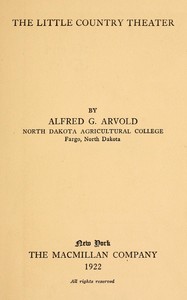
The little country theater by Alfred G. Arvold
Published in 1922, Alfred G. Arvold's The Little Country Theater is less a story and more a call to arms. Arvold, who ran the Little Country Theater at the North Dakota Agricultural College, didn't write a play. He wrote the instruction manual for a cultural revolution in rural America.
The Story
There's no traditional plot with heroes and villains. Instead, the book lays out Arvold's vision step-by-step. He explains why every small town needs a theater group. He talks about finding a space (a town hall, a barn, a cleared-out storefront). He gives practical advice on everything: choosing plays that reflect local life, building simple sets on a tiny budget, and casting regular townspeople as actors. The 'narrative' is his journey of proving that high-quality, meaningful theater could thrive far from Broadway. He shares successes and lessons from his own work in North Dakota, showing how drama can tackle local issues, celebrate community history, and bring people together.
Why You Should Read It
This book is a time capsule of incredible optimism. Arvold's passion jumps off the page. He truly believed that putting on a play could fight loneliness, build civic pride, and spark important conversations in a farming community. It's moving to read his faith in ordinary people as artists. Today, when we often just stream a show, his idea of culture as a hands-on, communal project feels radical and refreshing. You finish the book not just informed, but genuinely inspired to look at your own community differently. It makes you wonder what kind of play your town could put on.
Final Verdict
This is a niche book, but a wonderful one. It's perfect for history buffs interested in early 20th-century America, the Arts and Crafts movement, or rural life. Community theater enthusiasts will love it as a foundational text—it's like finding the original recipe for something you love. Most surprisingly, it's for anyone feeling cynical about their town or neighborhood. Arvold's unwavering belief in the power of people creating together is a potent antidote. It's a short, earnest, and powerful reminder that art belongs to everyone.
The copyright for this book has expired, making it public property. It is now common property for all to enjoy.
John Harris
5 months agoI found the author's tone to be very professional yet accessible, the practical checklists included are a great touch for real-world use. A refreshing and intellectually stimulating read.
Matthew Moore
2 years agoI've gone through the entire material twice now, and the visual layout and supporting data make the reading experience very smooth. A refreshing and intellectually stimulating read.
Susan Miller
1 year agoFrom the very first page, it manages to explain difficult concepts in plain English. Exceeded all my expectations.
Michelle Lopez
1 year agoWow.



David Johnson
2 years agoI decided to give this a try based on a colleague's recommendation, the historical context mentioned in the early chapters is quite enlightening. I'll be recommending this to my students and colleagues alike.