
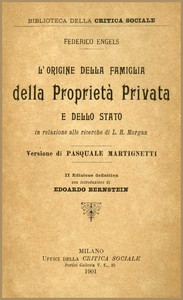
L'origine della Famiglia della Proprietà privata e dello Stato by Friedrich Engels
Let's be clear: this isn't a novel with a plot. The 'story' here is the story of us. Engels pieces together evidence from ancient societies, like the Greeks, Romans, and Iroquois, to build a timeline of human social organization. He starts with what he calls 'primitive communism,' where people lived in tribes, shared resources, and had more fluid family structures with women holding significant social power.
The Story
The big shift, according to Engels, comes with the development of agriculture and animal herding. For the first time, people could produce more than they needed to survive. This created a surplus. And that surplus led to the idea of private property—owning land, tools, and livestock. Men, who typically controlled this new wealth, wanted to pass it on to their own children. To do that, they needed to be sure who their children were. This, Engels argues, led to the overthrow of the old tribal systems and the creation of the patriarchal, monogamous family, designed to control women and ensure legitimate heirs.
With private property came classes—those who owned it and those who didn't. To protect their property and manage the conflict between these new classes, the wealthy needed a new kind of power. That power was the State. Engels describes the state not as a neutral referee, but as a tool created by the property-owning class to keep everyone else in line.
Why You Should Read It
You should read this because it's a foundational text that shaped a century of thought. Even if you disagree with every conclusion (and many do), the way Engels connects dots is brilliant and provocative. He forces you to see familiar institutions—marriage, police, courts—not as eternal truths, but as historical inventions with a specific job to do. It makes the modern world feel less fixed and more like one chapter in a very long book. Reading it is like getting a pair of X-ray glasses for society.
Final Verdict
This book is perfect for curious readers who enjoy big ideas and aren't afraid of a challenge. It's for anyone interested in history, anthropology, politics, or feminism. It's definitely dense in parts, and some of his 19th-century anthropology is outdated, but the core argument remains incredibly powerful. Don't read it for easy answers; read it to have your assumptions thoroughly shaken up. Keep an open mind, and you'll find it's one of the most thought-provoking books you'll ever pick up.
This is a copyright-free edition. Access is open to everyone around the world.
Jessica Gonzalez
4 months agoFinally found a version that is easy on the eyes.
Emma Hernandez
1 year agoSurprisingly enough, the arguments are well-supported by credible references. Don't hesitate to start reading.
John Garcia
11 months agoHelped me clear up some confusion on the topic.

Elizabeth Garcia
2 months agoIf you're tired of surface-level information, the attention to detail regarding the core terminology is flawless. I am looking forward to the author's next publication.