
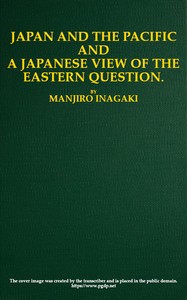
Japan and the Pacific, and a Japanese View of the Eastern Question by Inagaki
Published in 1890, this isn't a novel. It's a political pamphlet, a manifesto from a 29-year-old Japanese diplomat trying to explain his country's future to the Western world. Japan had just undergone the Meiji Restoration, transforming from a closed feudal society into a modern nation-state in a matter of decades. Inagaki was part of that new generation, educated in England, and he wrote this book in English to make his case directly to the powers that be.
The Story
There's no plot in the traditional sense. Instead, Inagaki presents a clear-eyed, strategic argument. He looks at the map and sees a problem: the European empires (especially Russia) are expanding aggressively into Asia, and China is weakening. He believes this creates a vacuum and a threat. His solution? Japan must step up. He argues that Japan, now modernized, has a duty and a right to take a leading role in East Asia and the Pacific Islands to ensure stability and keep other empires in check. He calls for a "Asiatic Confederation" with Japan at the helm. The second part of the book focuses on the "Eastern Question"—the decline of the Ottoman Empire—and draws parallels to Asia, suggesting the West should support Japan's rise as a stabilizing force. It's a bold, early pitch for Japanese leadership on the world stage.
Why You Should Read It
Reading this is a chilling and illuminating experience. You're not getting a dry history lesson; you're inside the mind of a clever strategist at a pivotal moment. What's most striking is how clearly he articulates ideas that would later drive Japanese foreign policy, for better and for worse. You can see the seeds of things to come. It's also fascinating to see his attempts to speak the language of Western geopolitics to justify Japan's place. He's not rejecting the imperial game; he's demanding Japan be allowed to play. The book feels urgent and prescient, which makes it incredibly compelling even today, as we watch new power dynamics play out in the same regions.
Final Verdict
This is a niche but powerful read. It's perfect for anyone interested in the roots of modern Asian geopolitics, Imperial history, or the psychology of rising powers. It's short, so it's not a huge commitment, but it's dense with ideas. You'll need to read slowly and maybe have a map handy. If you enjoy primary sources that let you hear a historical figure's voice directly, without a textbook filter, this is a goldmine. It's not an easy beach read, but for the curious mind, it's a captivating and sobering look at how one man's vision can echo through time.
This masterpiece is free from copyright limitations. It serves as a testament to our shared literary heritage.

Joseph Jones
7 months agoThe clarity of the concluding remarks is very professional.